
Shall We Gather at the River: From Brooklyn to Baptism
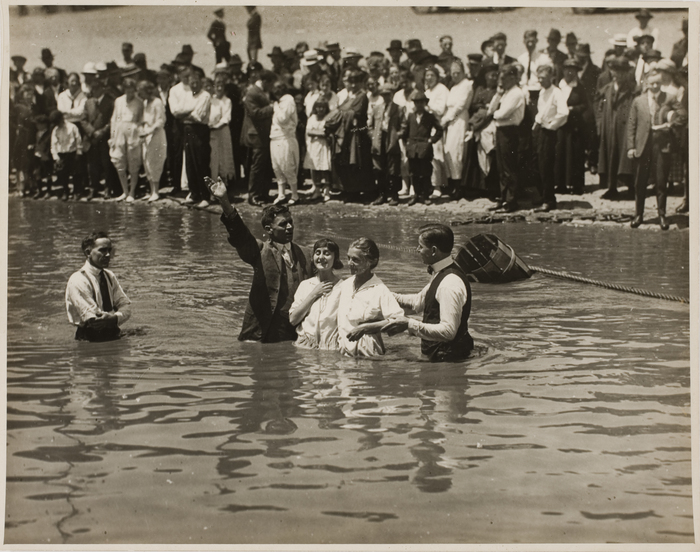
When I was a child, it was typical that whenever someone wanted to be baptized, most of the congregation drove out to Hart Park, where the Kern River made a small lake, and the baptism was there, a few yards offshore. The church members would bring along a few songbooks, and the group would sing, “Shall we gather at the river, where bright angel feet have trod, with its crystal tide forever flowing by the throne of God? Yes, we’ll gather at the river, the beautiful, the beautiful river, gather with the saints at the river, that flows by the throne of God”.
Often, baptisms were a night scene, lit only by headlights on the water in the evening after a church meeting. I don’t recall ever singing “Shall We Gather At The River” in the regular gatherings of the church when I was a child, nor do I remember ever singing more than the first verse and refrain for a baptism. It was a well-established custom to sing the one verse of that particular song for baptisms, and that’s how folks thought of that song.
A Vision of the Heavenly Throne
I did wonder sometimes whether the lake at Hart Park, with its murky water and large duck population, really fit the notion of “the beautiful river” where angels tread. When I finally really looked at the verses of the song as a young adult, I realized the author certainly wasn’t thinking about baptism when he wrote those words. Rather, he had in mind the scene in Revelation 22 (ESV) when John saw the throne of God at the center and peak of the heavenly city, which is the bride of Christ. The songwriter was visualizing the gathering of the redeemed in glory and trying to convey the joy and beauty of that grand assembly by the river of life.
Robert Lowry, who wrote “Shall We Gather At The River,” later reminisced that he’d written it on a hot, muggy day in Brooklyn when it was exhausting just to lie still and sweat. He pondered the better future God had promised and considered that a lot of songs made reference to the “river of death” and to grief and hardship, but he knew of none that celebrated the river of life. So, that day in 1864 when the American Civil War was raging, and New York was suffering a deadly typhoid epidemic, he wrote the words and tune that have been sung at countless baptisms in the 160 years since.
The Legacy of Shall We Gather at the River
He didn’t envision it as a baptismal song, but it quickly caught on. It was soon sung at baptisms in both the north and the south, including in military camps where a spirit of revival led to many baptisms even under enemy fire. I still occasionally see “Shall We Gather At The River” sung at a baptism, though it is much less common now than it once was, and perhaps riverside baptisms are less common too.
It is a curious phenomenon of human nature that a hymn written in Brooklyn in such tumultuous times would spread so quickly north and south, and that people who were literally waging war in a nation bitterly divided, were simultaneously singing the same trendy new song at baptisms, as well as singing the same traditional hymns in general and reading the same scriptures in their assemblies and Bible studies. It is tragic when a nation is divided against itself, and even more tragic when people professing to serve the Lord Jesus Christ take up causes that lead to conflict among Christians.
Unity Through Praise and Hope
When Paul wrote about Christians singing praises together in Romans 15:9-13 (ESV), he quoted verses from Deuteronomy and Psalms and Samuel and Isaiah, citing praise as a unifying force for believers from all nations under the rule of Christ. He concluded his scriptural exposition about unity in praise with the benediction, “May the God of hope fill you with all joy and peace in believing, so that by the power of the Holy Spirit you may abound in hope”.
Only God can fill people with joy and peace, and only believers can abound in hope by the power of the Holy Spirit. The world has no path to peace or hope or joy. The causes men rally around cannot produce such a unique gift as that which God provides believers. Such divine gifts must not be squandered on conflicts that stir within the kingdoms of this world. Paul often mentioned significant things he left behind to be a servant of Jesus Christ, and his ardent Jewishness, a kind of nationalism, was one of the things he surrendered. He accepted Jesus’ admonition to take up his cross and follow, and he firmly instructed Christians to die to the world in order to know peace in Christ:
But far be it from me to boast except in the cross of our Lord Jesus Christ, by which the world has been crucified to me, and I to the world. For neither circumcision counts for anything, nor uncircumcision, but a new creation. And as for all who walk by this rule, peace and mercy be upon them, and upon the Israel of God. (Galatians 6:14-16 ESV)
Crucified to the world, and the world crucified to me. That’s a radical departure from the demands and imperatives of the marketplace of commercial and political ideals, which cannot fill anyone with joy or hope, and certainly not peace. His prayer, in Galatians 6:16 (ESV), for peace and mercy upon all who walk by the rule of being alive to Christ and dead to the world, and upon the Israel of God, that’s a prayer worth praying, seeking gifts worth receiving in every generation and every place.
Shall we gather at the river? Come to the throne, take His cause above all else, be a peacemaker, let his peace rule in your heart, and pray for the peace of all God’s people.